

All podcasts
Infant mental health, co-regulation, and the parent-baby relationship | Dr. Dhruti Dholakia
November 3, 2026
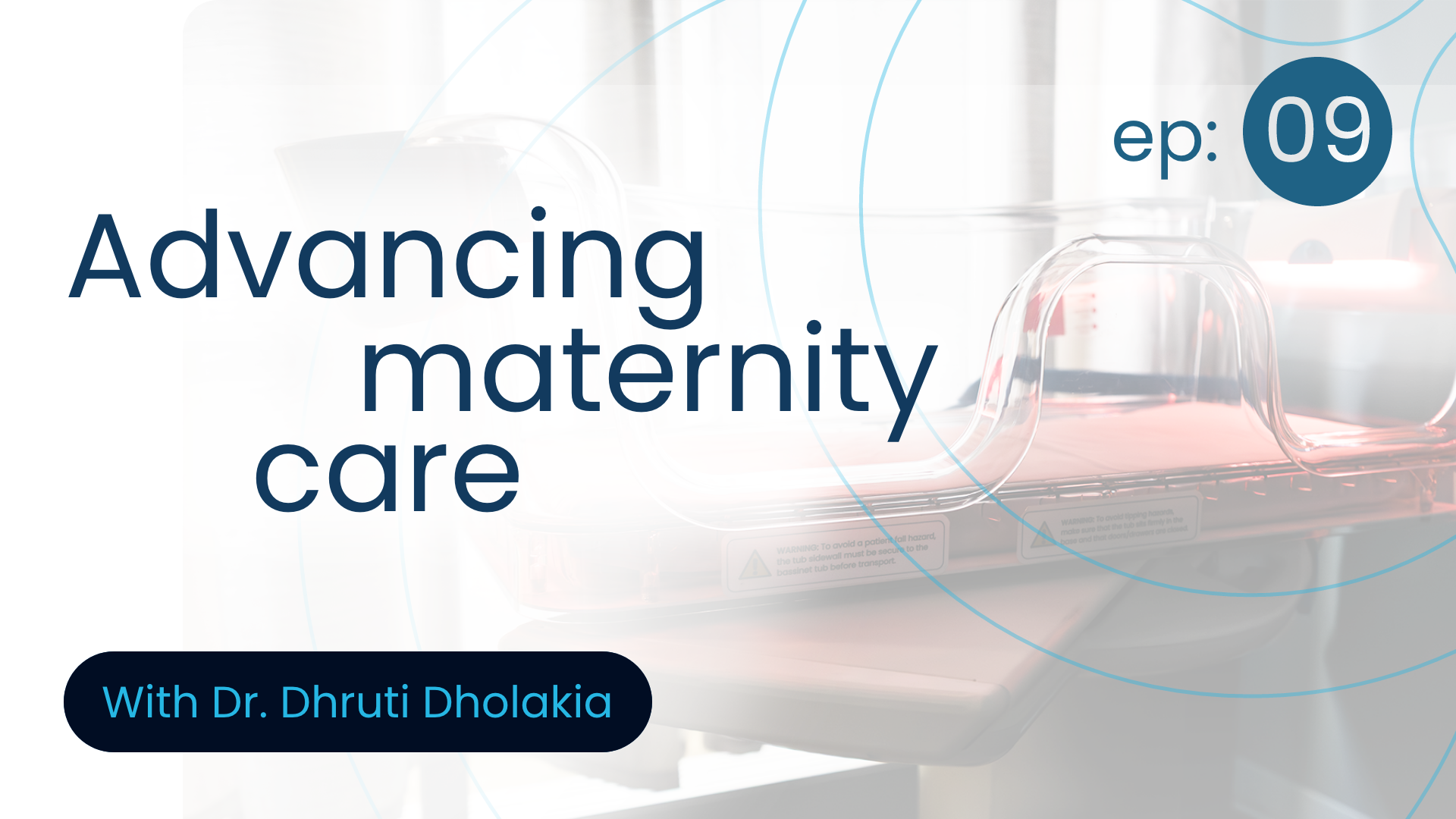
How do we support babies' emotional development by first supporting the adults who care for them?
In this episode of the Advancing Maternity Care podcast, Veronica Kemeny, Director of Clinical Success at Couplet Care, welcomes Dr. Dhruti Dholakia, an infant and early childhood development specialist, educator, researcher, and consultant whose work focuses on strengthening the relationships, adults, and systems that shape children's everyday experiences. Dr. Dholakia holds a Ph.D. in Infant and Early Childhood Development from Fielding Graduate University and is a Licensed Clinical Mental Health Counselor and Registered Play Therapist, with training in Theraplay, mindfulness, and yoga. Dr. Dholakia explains what infant mental health is and why it matters from birth, describes how adults' nervous systems and co-regulation shape parent-baby relationships, and shares her personal experience of recovering from a difficult birth. The conversation also explores her perspective on how the Couplet Care Bassinet can support access, safety, and connection in the early postpartum days.
Discover why Dr. Dholakia describes caring for parent and baby together as "the big and.”
Chapter list:
00:00 Welcome and Guest Intro
01:07 Dhruti’s Work and Mission
02:16 What Is Infant Mental Health?
04:05 Babies’ Earliest Emotional Needs
06:54 Nervous System and Co-Regulation
12:31 Postpartum Care System Gaps
15:20 Creating Safety by Normalizing Feelings
18:11 How Couplet Care Helps Families
21:05 A Mother’s Story After C-Section
24:21 Access, Agency, and the Parent-Baby Dyad
29:16 It Takes a Village
30:32 Closing and Next Steps
Note: The transcript has been lightly edited for clarity. Acronyms mentioned in this episode include:
- DIR (Developmental, Individual-differences, Relationship-based): A framework developed by Dr. Stanley Greenspan for understanding how emotional relationships support a child's development
- FEDCs (Functional Emotional Developmental Capacities): Milestones of emotional development within the DIR framework. The first three, discussed in this episode, are regulation and interest in the world, engaging and relating, and intentionality and two-way communication
[00:00:00] Veronica Kemeny: Welcome to the Advancing Maternity Care podcast. I'm Veronica Kemeny, Director of Clinical Success at Couplet Care. In this podcast, we invite maternal, infant, and family health thought leaders to share their perspectives and work. Connecting around research and lived experiences is key to implementing more meaningful support for families and those who care for them. Today, I'm excited to speak with Dr. Dhruti Dholakia, who's an infant and early childhood development specialist, educator, and consultant dedicated to transforming the relationships, leadership, and systems that shape children's everyday lives. She holds a PhD in infant and early childhood development from Fielding University, along with credentials as a licensed clinical mental health counselor and registered play therapist. She's also certified in Theraplay and as a yoga practitioner. Dhruti, thank you for taking time to share your insights with us today.
[00:00:52] Dhruti Dholakia: All the thank you is to you. Thank you for inviting me. You're having some really important discussions from what I hear, and an amazing kind of work that you do. So I'm so honored to be a part of this. Thank you.
[00:01:05] Veronica Kemeny: Thank you. I appreciate it. I would love to hear a little bit about your current work and what is driving you day to day given your expertise in infant mental health
[00:01:17] Dhruti Dholakia: Oh, how much time do we have? Let's see if I can summarize it. Yeah. So my work actually centers on helping... My work now, I should say, current work, right? I come with about 34 years of experience of working with the system of care that our little ones, their families, but currently, what I want to focus on is helping the adults who shape the children's lives and build their awareness, build their relationships, and the systems that help these children thrive. And what drives me is the possibility of changing the child's everyday experience by supporting the adults and the environment around the child. So that's my, in a nutshell, that's the scope of work.
[00:02:05] Veronica Kemeny: Yeah. So a lot of work, especially given your expertise with children, including littles, very littles, you cannot remove the work with the parents, right? And in supporting the parents. So with your doctorate, it'd be really helpful to explain maybe what infant mental health is, as it is I'm sure an unfamiliar concept to a lot of people. Can you explain what it is and why it matters starting at birth?
[00:02:30] Dhruti Dholakia: Absolutely. So, many, many, many times, or I should say very often, when I say “I support infants too, like, I'm in infant mental health”, the first question, you're right, it's unfamiliar, people say, "Infant mental health?" Like, "Infants have mental health? Infants have issues?" Like, "How young do you see?"
[00:02:49] Dhruti Dholakia: And I go, "Babies." And it is such - it comes as such a surprise and a shock to people. But what we have to remember and understand is that infant mental health is about a baby's developing emotional life, right? Experiencing feelings, finding comfort with help, forming relationships, and gradually exploring the world, right? Babies communicate before they have words, through crying, through movement, through facial expressions, and changes in their environment, in their engagement, right? So this responsive back and forth, these exchanges, help found the foundations for infant mental health, for their communication, for their social skills, for their emotional wellbeing.
[00:03:35] Dhruti Dholakia: And if you might, so for example, a baby makes a sound, and the caregiver responds, and then the baby responds again, and this tiny exchange is already showing us relationship in action. So infant mental health is actually supporting the development or formation of that relationship, that attachment with the child's adult caregiver in life.
[00:04:03] Veronica Kemeny: Yeah, beautifully said. So what would you say with infants, what are some of those earliest emotional needs that babies have that caregivers should know about?
[00:04:14] Dhruti Dholakia: Yeah. Before I jump into that, I do wanna say that before babies can tell us how they feel, they're already experiencing how it feels to be with us. Dovetailing into that, into this question, the beautiful question is, what are some of the earliest emotional needs of babies is really well described, when I was doing my doctoral work at Fielding. We were introduced to the functional emotional developmental capacities, and this comes from, Dr. Greenspan's DIR framework. It's a way to understand how emotional relationships support development, and they focus on three capacities, let's say, you know, those the first three that emerge progressively through infancy.
[00:05:00] Dhruti Dholakia: And they are regulation and interest in the world, the engaging and relating, and intentionality and two-way communication. So these are the earliest emotional needs of babies. Regulation, yeah? Helping the baby become more comfortable and comfortable enough at least to understand and attend to people and their surroundings, noticing whether sound, light, touch is overwhelming. The other, emotional, need is that of engaging and relating, which means if we can offer them warm, enjoyable connections through voice, expression, caregiving that fits the baby's preference, where the baby understands that my preference, what I like is seen, that I-- my needs are met, right? And then they communicate that back.So intentionality and the two-way communication, like noticing an emerging gesture, an expression, or sound. And, and then those three basic needs of the child is what we as their caregivers have to keep in mind.
[00:06:12] Veronica Kemeny: Yeah.
[00:06:12] Dhruti Dholakia: And these at different rates, though, just to keep in mind too, that they develop at different rates. They're just a guide for understanding and supporting the child's needs.
[00:06:22] Veronica Kemeny: So it sounds like really there are some general needs, but how the baby's communicated or the rate at which their needs are developing is gonna be different. But all in all, it sounds like that responsiveness between the caregiver and the baby.
[00:06:36] Dhruti Dholakia: Responsive caregiving.
[00:06:37] Veronica Kemeny: Following the baby's lead.
[00:06:38] Dhruti Dholakia: Yes. Notice the baby in front of you, respond, and then leave space for their response. That two-way communication, building the space in, and that is responsive caregiving. Yeah.
[00:06:52] Veronica Kemeny: Oh, beautiful. Beautiful. so I'm curious where the nervous system actually comes into play here, right? Even just thinking about, obviously we're talking about infants, who are now in the world, but even just thinking about in utero, that they respond to the, especially the birthing person, their body and their nervous system. But I'm thinking about even the baby's nervous systems themselves. How does nervous system work come into play as you work with families, and how can that be incorporated into our parenting, even in those early days in pregnancy?
[00:07:26] Dhruti Dholakia: Such a beautiful and yet a heavy question, right? So without making it very heavy with scientific jargons, how about we try and simplify it, make it simple?
[00:07:38] Veronica Kemeny: Yeah.
[00:07:38] Dhruti Dholakia: And so the nervous system, which is our body, and mind together, it's one working all the time. And our job as caregivers, as adults, or as clinicians working with parents, but the individual, the adult in the life of a child, if each individual can pay attention to what is happening in their body as well as what is happening with the people around them or wondering what they're thinking and saying and how their response is affecting them, similar to what I just talked about in the FEDCs.
[00:08:19] Dhruti Dholakia: So being aware of, really embodied awareness of what is going on with me as an adult, and what am I bringing in this interaction with the other. So if your question is how can we help our parents, how do I work with parents in this role, I first start with me. How do I show up? What am I bringing to this? And then being aware, noticing what's going on, and also addressing things that are not going to help me be more present in that interaction with the other adult. So addressing those, whether that be “I haven't had enough caffeine today”, or that maybe, I am feeling one way or another. Figuring that out and then showing up to be present with that parent, which then models to the parent and calms the parent's nervous system down, which then models to them what does co-regulation look like.
[00:09:17] Dhruti Dholakia: Because the parents, this is a new baby. Maybe they're anticipating a new baby. Maybe, you know, they've had the new baby. But they're, they have a lot, a lot going on. So we show up present and our nervous system is calm. Every part of us is available to listen to and respond to, not react, respond to this parent's needs and to make the parent feel seen. Once we model that, the parent experiences what that feels like and is then able to give that to their baby in return, right? So that circle or even that parallel process, is extremely critical in the nervous system world.
[00:10:02] Veronica Kemeny: Yeah, beautifully said. I think as we think about these moment-to-moment interactions, even with healthcare providers, I often think about is just the slowing down, which is easier said than done in a busy medical setting. There's appointments, people running behind. It is just very hard to be present and attuned. So oftentimes I love to stress with providers that moment of taking a moment for yourself before you walk into the patient's room, right? Or as you do approach the room, really slowing down to explain things, offer opportunities for questions. Because to your point, if you as a provider are coming in with less of that sort of frantic energy, the parents are gonna feel more regulated, and as you said, co-regulated.
[00:10:54] Veronica Kemeny: Which actually we might wanna stop here and def- define that because co-regulation is incredibly important. 'Cause we often think of ourself, our ability to regulate ourself, right? Deep breathing and walking and mindfulness, right? Like we think about what can I do? But co-regulation in any relationship, even with a provider, and a patient is really important.
[00:11:14] Dhruti Dholakia: Absolutely. And a baby, if you think about it from an infant's perspective too, a baby needs help managing distress. A baby's not born knowing. Baby knows how to... Baby is aware, I believe, this is Dhruti's talking, educated talking, but still it's Dhruti talking. Babies come into this world with the capacity, right? That's where the capacity, functional and emotional developmental capacity. Babies come with their own individual capacity into this world, and now it is up to us to develop, to hone, to nourish, to foster, to nurture that capacity. And so babies need help in that capacity, development of managing distress, how they can learn about their own feelings and emotions through another.
[00:12:06] Veronica Kemeny: Yeah.
[00:12:06] Dhruti Dholakia: That's how they learn.So that co-regulation is managing that emotion and feeling together. Regulating and co-regulating. And once we do that through co-regulation, the baby eventually then learns to self-regulate. But it starts with co-regulation, attunement of the adult. So I can go on and on and on.
[00:12:31] Veronica Kemeny: Dr. Kristin Tully, the founder of Couplet Care, often talks about bringing humanity into these early days, especially when we're thinking about those postpartum as they're going through delivery, birth, and postpartum. I'm curious what you see as opportunities for the system of care for these early weeks of postpartum, of birth. What, where do you see some opportunities for improvement?
[00:13:00] Dhruti Dholakia: Goodness. Yes. I think what I have found, I guess, over the years in working with our families is that in order to help our littles, very littles, we need to focus our, approach in helping the parent, in helping the moms, in helping the caregivers. I guess I would say that I'd like us to care for more the parent, the baby, and the relationship between them, right? Which is a care that recognizes that parent-infant relationship as being central to both maternal and infant mental health. Keeping both of theirs. And so that opportunity is providing care alongside physical recovery and growth, right?
[00:13:52] Dhruti Dholakia: We need to support their developing connection. Supporting attachment means helping parents become curious about their baby's signals and gradually discover what brings comfort and connection. So it also means recognizing how much parents, need someone else to notice and respond to their own needs.
[00:14:12] Dhruti Dholakia: So I'm not sure if this is directly addressing the opportunities, but this is where I see we could do more of.
[00:14:19] Veronica Kemeny: Right.
[00:14:20] Dhruti Dholakia: Caring for.
[00:14:21] Veronica Kemeny: That is very well said. I think oftentimes as in, in my experience as a perinatal mental health specialist, we often talk about, especially around mental health, but even just the physical health of sort of this “hot potato” of parents who are pregnant are seen through OBGYN, then they go through the experience, they're followed usually at a six-week checkup, and then they're sort of released back to their ongoing provider, right? A primary care. But the reality lot of adults don't have a primary care established, unfortunately. have a good relationship. It might just be something maybe they do once a year. or even if they do, it's again, it's more so, "Oh, I go when I'm sick," versus it being this relational experience of “I'm feeling off.” So I think this is a great opportunity where even I know there's been more efforts in pediatric care to be checking in on the parents just because they do see them very regularly in their work to be following babies' early needs and developments, right?
[00:15:19] Dhruti Dholakia: Yeah. And you know, we often ask “How is the baby feeling?” And, whether the baby is feeding well and sleeping well. But I would also ask, or like us to ask: “How is the parent experiencing their baby?” It's, it's just opening that question up to them, right? Do they feel connected? Do they feel uncertain, overwhelmed, supported?
[00:15:40] Dhruti Dholakia: “How do you feel?” Asking the parent. And oftentimes I found ... Not often, I found almost every time when we open these questions up to the parent, the vulnerability becomes normal. We're normalizing the parent's state of being. They're often so judged by the outside world, and especially those of us who may not have the supports, like you were saying. They don't have the, even the most critical supports networks, they don't have. And just asking about them, those mothers or parents, just opens up a whole new dimension to caregiving, to relationships. a whole new dimension to the parents being available for their child because now we've opened it up. The parents aren't offhandish. They don't feel unseen, or they don't feel like, "Here's our baby. I'm behind the, the mask here." So.
[00:16:40] Veronica Kemeny: Yeah, I'm really glad you mentioned normalizing because I think the most important thing, especially around healing, whether it be the physical healing or the emotional transition, is there can be a lot of shame in sharing how you're feeling. You don't know what's normal. and so I'm glad you normalized because even asking the question, even if it's not appropriate or it's not relevant to them of, you know: “Are you having any scary intrusive thoughts? What is your sleep like? What's it like to be able to trust your partner with the caregiving so that you can get some rest?” Right? Normalizing that it's okay to have lots of conflicting emotions, and sometimes some really hard emotions, that allows them to know this person who asked me this question is a safe person, so even if I don't open up now, I might in the future. It really, it opens up that, that moment. Yeah.
[00:17:33] Dhruti Dholakia: And the space and the word that you put in there was “safe.” The feeling of safety. If our parents feel safe, in that moment through co-regulation and through... So going back to all the questions that we've discussed so far, our nervous system helps create this space for safety. So if we feel safe in our nervous system, we're bringing into that, that energy into the room. And of course, not to mention the environment and, creating energy, the vibe, the parent feels safe, and so on and so forth.
[00:18:09] Veronica Kemeny: Yeah. Yeah. The environment is so important in general, right? Of how we show up in the world depends a lot on our environment, whether it be our home environment, our work environment, or as we're talking about maybe this pregnancy, birth, postpartum environment, for whether that be a birthing center, whether that be a home birth, whether that be a hospital birth, that is, you know, those environments are gonna vary. And so given what you know about our work with the Couplet Care and our real desire to shift the quality of care and move the, especially hospital birthing system, to be more focused on respect and access, safety, safe sleep, making sure that there's that access without needing to bring in somebody else, right?
[00:19:00] Veronica Kemeny: Just saying, "Hey, you are a caregiver who needs to, has this biological urge, and this need to care for your infant. Let's remove those barriers," right? So I am curious, how you see the Couplet Care Bassinet shifting that postpartum experience moms and infants and families in those early days while they're still in the birthing center, or in the hospital?
[00:19:23] Dhruti Dholakia: Yeah. And again, before we jump into that, just kudos to this really amazing work you're doing at Couplet Care. Because, you know, what Couplet Care does is, and please do correct me if my understanding is inaccurate, but what I understand, the environment, includes, let's say, like you said, whether it's home or hospital or anywhere that the parent has given birth, what Couplet Care is doing is giving an opportunity by, offering an over-bed bassinet. Right?
[00:19:55] Veronica Kemeny: Mm-hmm. Yeah
[00:19:57] Dhruti Dholakia: To improve the mother's ability to see and connect and access, right? So talk about ... their baby. So talk about environment, right? What interests me is how the physical environment, we know this, we've talked about this, can make connection easier, yeah, with a baby. There is ... We often talk about relationships as though they happen, independently of the room, right? The equipment or the parent's physical comfort. But no, this very simple and basic and yet incredibly critically important: the mother's access to the baby in the first few hours and days of birth are so incredibly important. And the environmental aspect must be considered, which is what Couplet Care has done.
[00:20:48] Dhruti Dholakia: So again, lovely, beautiful work. So easier access would create more opportunities for the parent to notice those small cues, speak to the baby, participate in the care, particularly when movement is difficult after birth.
[00:21:04] Veronica Kemeny: Right.
[00:21:04] Dhruti Dholakia: I remember this. Is it okay for me to share a little bit of..?
[00:21:08] Veronica Kemeny: Of course, please.
[00:21:09] Dhruti Dholakia: I'm a mommy of two. My older child was born post due date. I had gestational diabetes, and I had a very difficult, birthing experience, very difficult birthing experience. So I had C-sections, and even those were complicated. The stitch in that one C-section, even that was complicated. And movement was painful. And back in the day, now my child is now 30, going to be 31 soon, but back in the day, parents, mothers would only be in the hospital…my husband had to fight for me to stay in the hospital for more than 24 hours. So in that time when my child was born, with her, their own complications, I wish I had this bassinet back then.
[00:21:57] Dhruti Dholakia: Because I remember the feeling of helplessness. I remember the feeling of angst. I remember the feeling, I have goosebumps thinking about it.
[00:22:06] Veronica Kemeny: Yeah.
[00:22:07] Dhruti Dholakia: How I cannot be there to support my child when the nurses had to come, a few nurses, my husband, but I felt like, to be honest, I felt like I did all the hard work, yo. I gave birth, I have the stitches, I have the pain, and somebody else gets to hold my baby?
[00:22:26] Dhruti Dholakia: No. So that added, that environment of people coming in and out and helping my baby when she had, they had their own needs, that was tough. So what Couplet Care is offering is that opportunity, you know, that connecting, giving me the agency, I guess, to be able to reach my child, given my capacity, right? I can be on bed, can bend over, not, et cetera. So I think greater independence is also offered by the environment. The access to the things that we have in our environment is also something that matters a lot. Like I said, agency.
[00:23:11] Veronica Kemeny: Yeah. Yeah, thank you for that vulnerability and sharing your story. And, you know, I think what's so interesting is there's a universality to what you're saying. So many families, whether it be you gave birth 30, 40 years ago or even in the last few years, the experience in the hospital has not shifted a lot in terms of the, the environment, and specifically the bassinet, right? And so I think we're talking a lot about, and, possibly at your time when you gave birth to your older child, you know, right now rooming in is the experience where it is encouraged for the baby to remain with the parents as long as possible, and that changed about 30 years ago. But really the design of the bassinets have remained the same, right?
[00:23:57] Veronica Kemeny: So even though prior it was more so you gave birth and the baby was wheeled in and out of the nursery, and brought to you for feeding, now the expectation is the baby is with you as much as possible, which is a wonderful movement forward, but the equipment never shifted, right? And that's where I think you're saying that stretching despite having scars is happening because the bassinet has never been designed for you to reach and have agency.
[00:24:21] Dhruti Dholakia: Yes, I think this, yes, this design I believe offers a really plausible way to reduce the barriers to interaction, to care.
[00:24:31] Veronica Kemeny: Yeah
[00:24:32] Dhruti Dholakia: And, yes, in the hospital extremely critical, but I also do feel that it's great to ...when you go home. 'Cause hospitals don't keep you until you're fully healed. You go home after a couple of days. Even if it is home birth, it doesn't matter. But having the baby right there at night, going back, all of this, going back to nervous system and safety, if the mom feels, or the other caregiver parent, they feel safe and comfortable in their own being, their nervous systems are calm. They're regulated, right?
[00:25:07] Dhruti Dholakia: If they're regulated and they're able to give that to their baby, because in those early infancy, days even, our baby can sense the tension in your touch. Our babies can sense the tension in the feeding too when that happens, right? So when we're able to be in that more comfortable, relaxed place, we are helping shape the infant's mental health by shaping the infant's nervous system. So me as a mommy, calm and relaxed and safe and happy, is a calm and relaxed and safe and happy baby. Co-regulation, developing, all of that.
[00:25:48] Veronica Kemeny: Yeah. Yeah, beautifully said. Beautifully said. So important, and foundational for the parents' experience in those first days of just being the true foundation of their entryway to parenthood, right? But the babies as well. And so I think, I hear both of us saying, you know, the increasing the access, both physically and emotionally, is in the best interest not just of the patient's experience, the mom's experience, but of course the baby as well, right?
[00:26:20] Veronica Kemeny: So baby most likely is then, or, certainly feeling if mom is feeling anxious because she's like, "I need to put the baby down, but I can't reach," right? "And now I'm quivering 'cause I'm nervous to put my baby down. Am I... You know, do I have a good grip on them to put them down," right? Or, "I'm feeling discomfort in my abdomen and the rest of my body after a delivery," after a difficult delivery or even a standard delivery where everything goes well, the baby's gonna feel that discomfort, right? So the more we can support the physical and emotional recovery, the better for the baby and that relationship. Wow, beautiful.
[00:26:57] Dhruti Dholakia: It is the and, the big and. It is the mother and the baby. That, that is the, I think what Couplet Care, even the name is so beautiful, is the couplet care. It is you're taking care of the couple, the dyad, the parent and the child so that we have to ... It's not either or. It's not individual. It is the “and.”
[00:27:25] Veronica Kemeny: Beautiful. Beautiful. Yes, it's, it's so thrilling to be able to speak with someone who so easily gets the work, and the goals, and the values of our team to bring our bassinet to become a standard of care, to really elevate and meet the parents where they're at emotionally and physically, and needing– giving them the access they need and they deserve in those early days so that it can flourish, right?
[00:27:58] Veronica Kemeny: The relationship can flourish, their identity can be founded. So it's a true joy to hear you bring in the really unique perspective of what the baby needs, right? Because oftentimes we don't, we don't think about them. We think obviously, how are they doing? Are, you know, are they meeting their milestones? Are they eating? Are they growing? How are they sleeping? But how are they feeling, right? That's not often something that's brought into conversation.
[00:28:25] Dhruti Dholakia: Yes, and acknowledging even those children who hit their milestones are likely hitting them not only because physio-biologically, and they have the other things which are silent that are not often talked about, that they are getting those. That's why they hit their milestones so well. I look forward to this, you know, and I have two children, and I look forward to this Couplet Care, the, the bassinet genuinely. I, I can't wait even as a grandparent, I'll be older and then like it's a bassinet for me too. So I'm going beyond the mother-child or the father-child or, you know, I'm going beyond that. Any caregiver, taking care of our baby.
[00:29:11] Veronica Kemeny: Yeah.
[00:29:12] Dhruti Dholakia: It- this is a beautiful design for sure.
[00:29:14] Veronica Kemeny: Thank you. Thank you. Yeah, I think you actually are highlighting one of my favorite features. I think it's more obvious the benefits to the birthing person, the mom, but I truly love showing nurses and teams how the bassinet can be utilized with the other caregiver, including extended family and family friends, because the same safety benefits, the same connection, the same access are available to grandparents and aunts and best friends, right? Where they can bring the bassinet over their lap in a seated position and really caretake, which means it is a safe environment for you to get to know baby and support the birthing person who's recovering as well.
[00:30:01] Dhruti Dholakia: And we are a village, everybody. So all these village people will be helping our baby in the same way, right? So even this goes across cultures, this goes across, anybody's approach to caregiving. If we're taking that village approach, then anybody and everybody and the baby gets a consistent quality and consistent standard of care, no matter where the baby goes.
[00:30:29] Veronica Kemeny: Right.
[00:30:30] Dhruti Dholakia: Yeah.
[00:30:30] Veronica Kemeny: Thank you. Wow, beautiful. Thank you so much for sharing your experience, your extensive expertise, and clearly your passion for families. Truly, it is beautiful the work you've done, and we look forward to staying in touch and hearing more things that are coming from you.
[00:30:47] Dhruti Dholakia: Oh, pleasure. Yeah, I look forward to collaborating with you.
Discover the innovative Couplet System of Care
Explore the bassinet designed to connect families safely, promote bonding, and provide exceptional support for parents, infants, and clinical staff.